


How Do Lasers Work? Different Types of Lasers

Lasers are fascinating devices that produce a narrow, powerful beam of light unlike anything we see in everyday illumination. From CD players and printers to medical surgery and engineering, lasers quietly play a vital role in modern life, far beyond their famous appearances in science fiction.
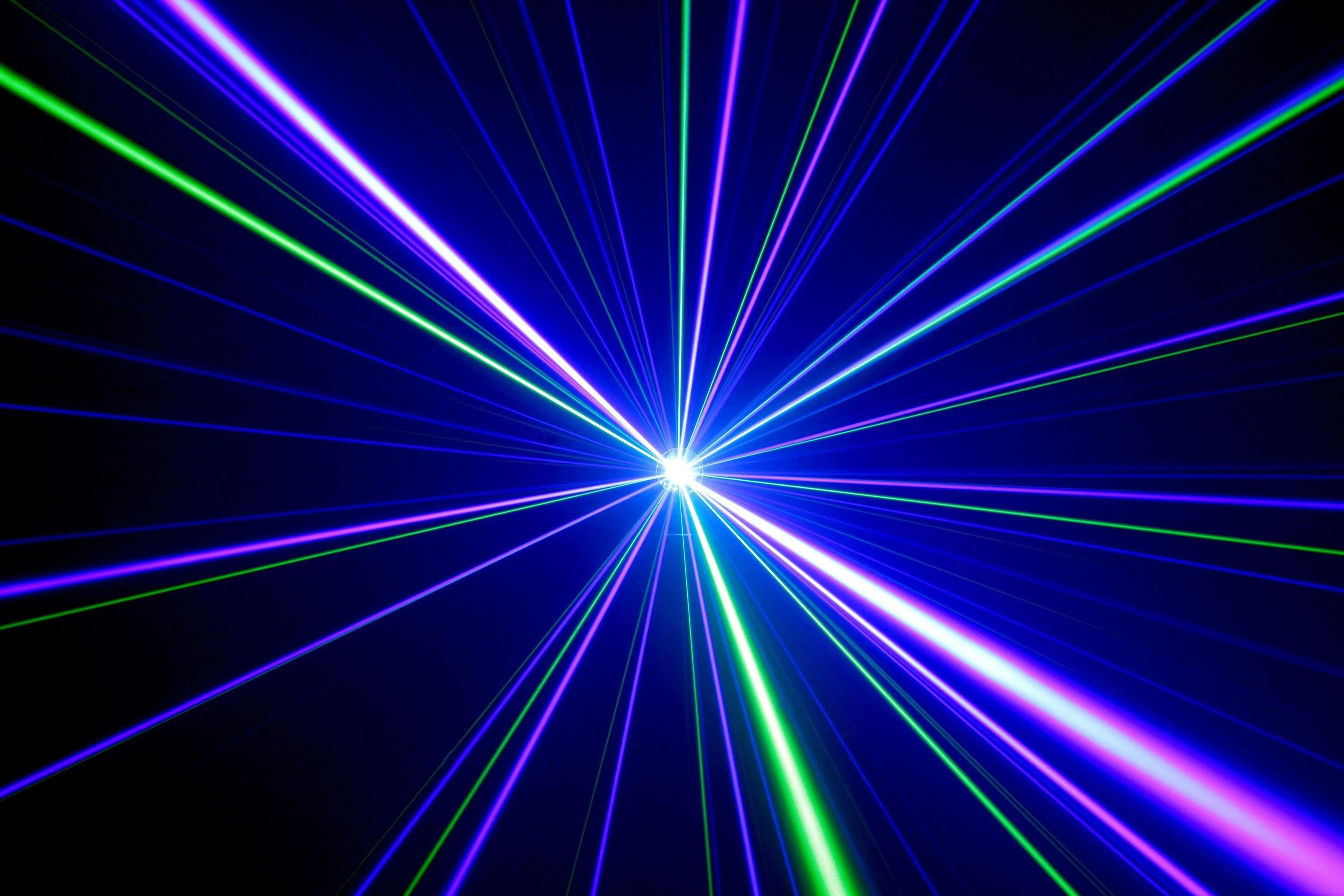
But how exactly do lasers work?
What Is a Laser?
The word LASER is an acronym for Light Amplification by Stimulated Emission of Radiation — a name that perfectly describes the process behind laser light.
A laser produces light by energising atoms and controlling how they release that energy in the form of photons. Unlike ordinary light, laser light is highly organised, concentrated, and precise.
The Basic Principle Behind Lasers
At the heart of every laser is a lasing medium, which can be a solid, liquid, gas, or semiconductor. This medium is “pumped” with energy, usually through intense light flashes or electrical discharges, to excite its atoms.
When atoms absorb energy, their electrons jump to higher energy levels. This creates what scientists call population inversion, where more atoms are excited than relaxed, a critical condition for laser operation.
As excited electrons return to lower energy states, they release energy as photons. These photons have very specific wavelengths, meaning they are all the same colour.
Stimulated Emission: The Key to Laser Light
Laser light is made possible by a process known as stimulated emission.
When a photon encounters another excited atom, it can trigger that atom to release a second photon that:
- Has the same wavelength (colour)
- Moves in the same direction
- Is in perfect phase with the first photon
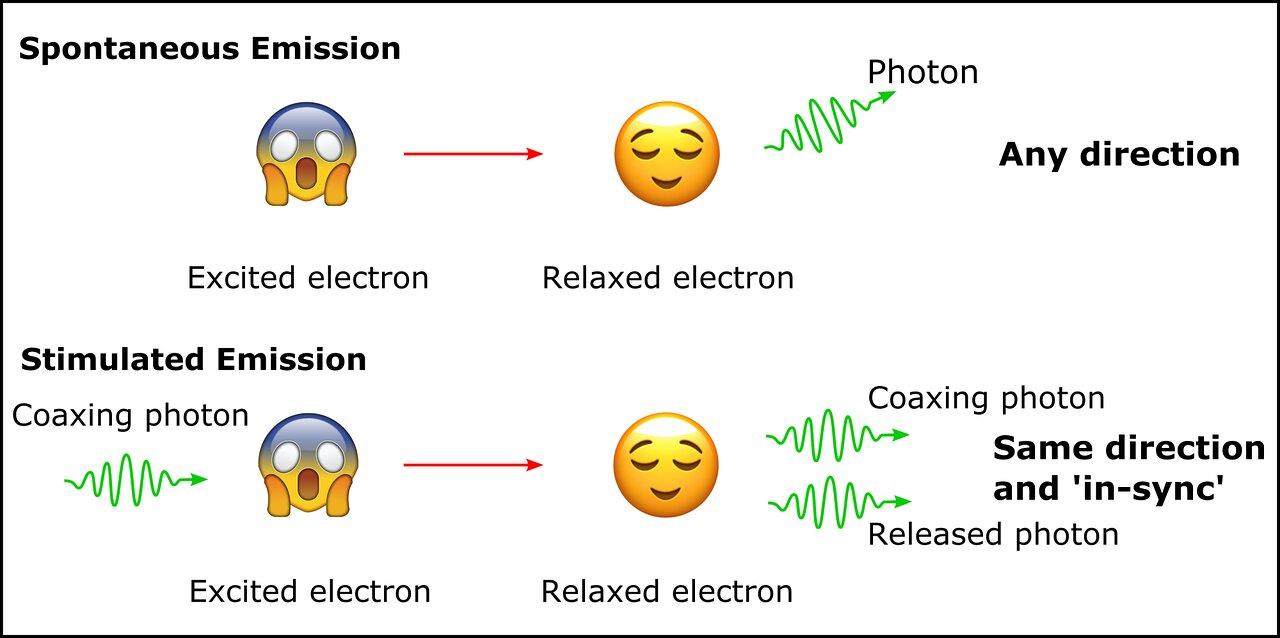
This creates a chain reaction, producing a cascade of identical photons.
Mirrors and Amplification
A laser contains two mirrors at either end of the lasing medium. Photons bounce back and forth between these mirrors, stimulating more emissions and amplifying the light.
One mirror is partially transparent (half-silvered), allowing some of the light to escape. This escaping light forms the laser beam, intense, narrow, and highly focused.
Unique Properties of Laser Light
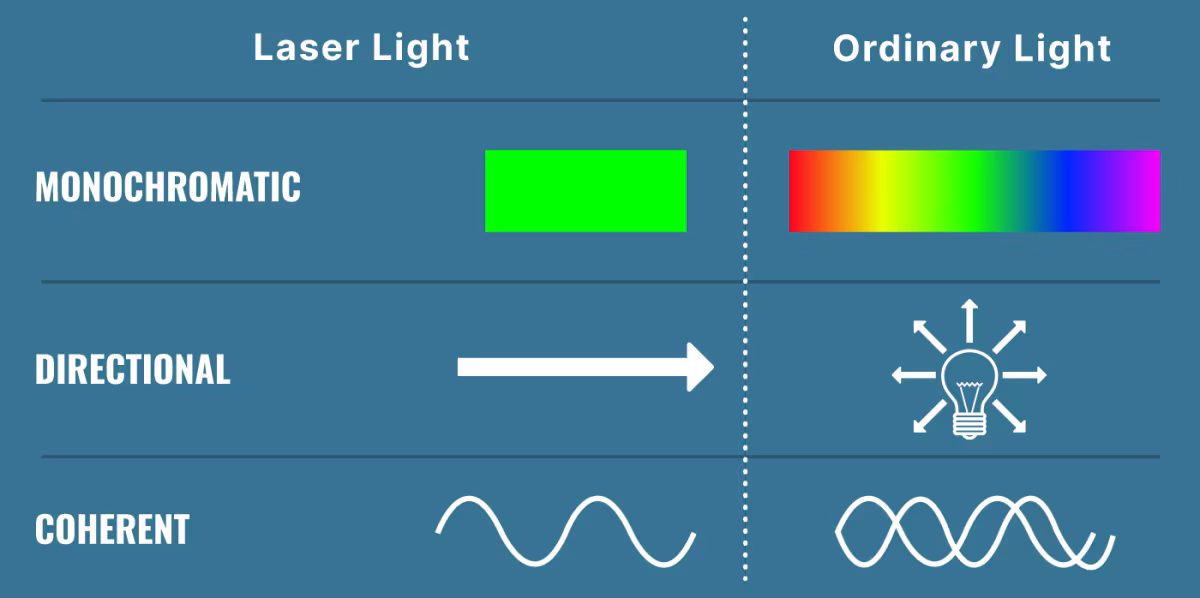
Laser light has four defining characteristics:
1. Monochromatic
It consists of a single wavelength (one colour).
2. Coherent
All photons move in step with one another, producing a highly organised wave.
3. Directional
The beam is extremely narrow and concentrated in precise direction, unlike a flashlight which spreads light in all directions.
4. High Intensity
Because the energy is concentrated in a single direction and wavelength, laser light is incredibly bright and powerful.
Types of Lasers and Their Uses
Solid-State Lasers
These use a solid crystal, such as ruby or neodymium-doped YAG (Nd:YAG).
- Emit infrared light
- Used in medicine, industry, and scientific research
Gas Lasers
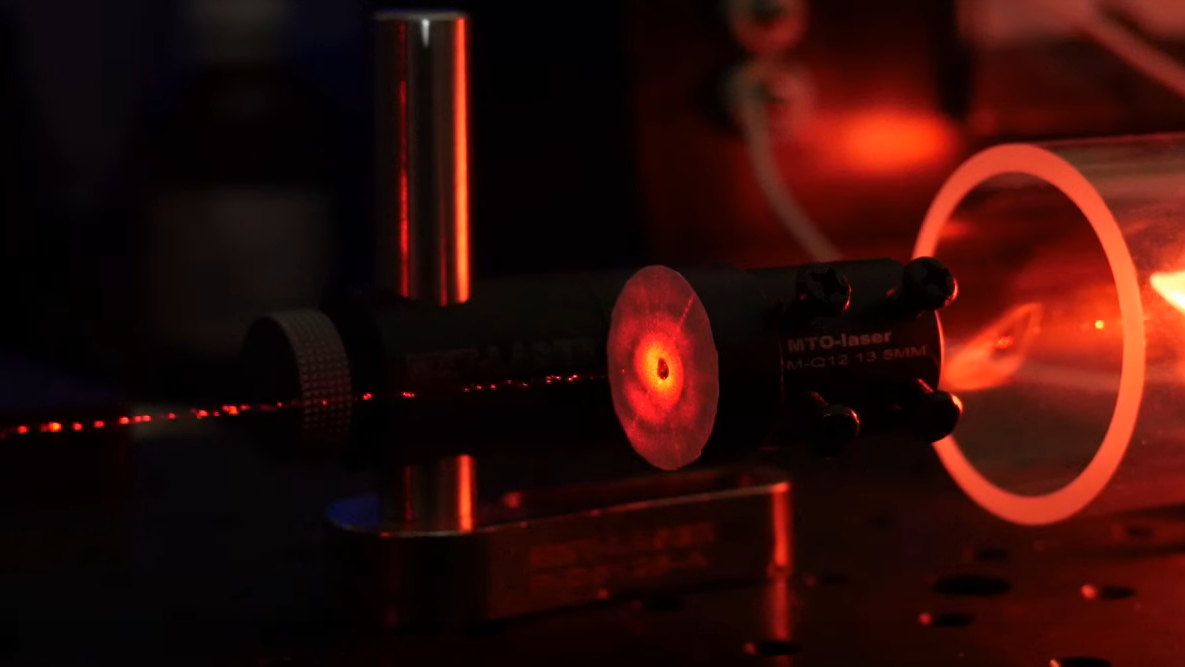
Common examples include helium-neon (HeNe) lasers and CO₂ lasers.
- HeNe lasers produce visible red light
- CO₂ lasers are used for cutting and engraving hard materials
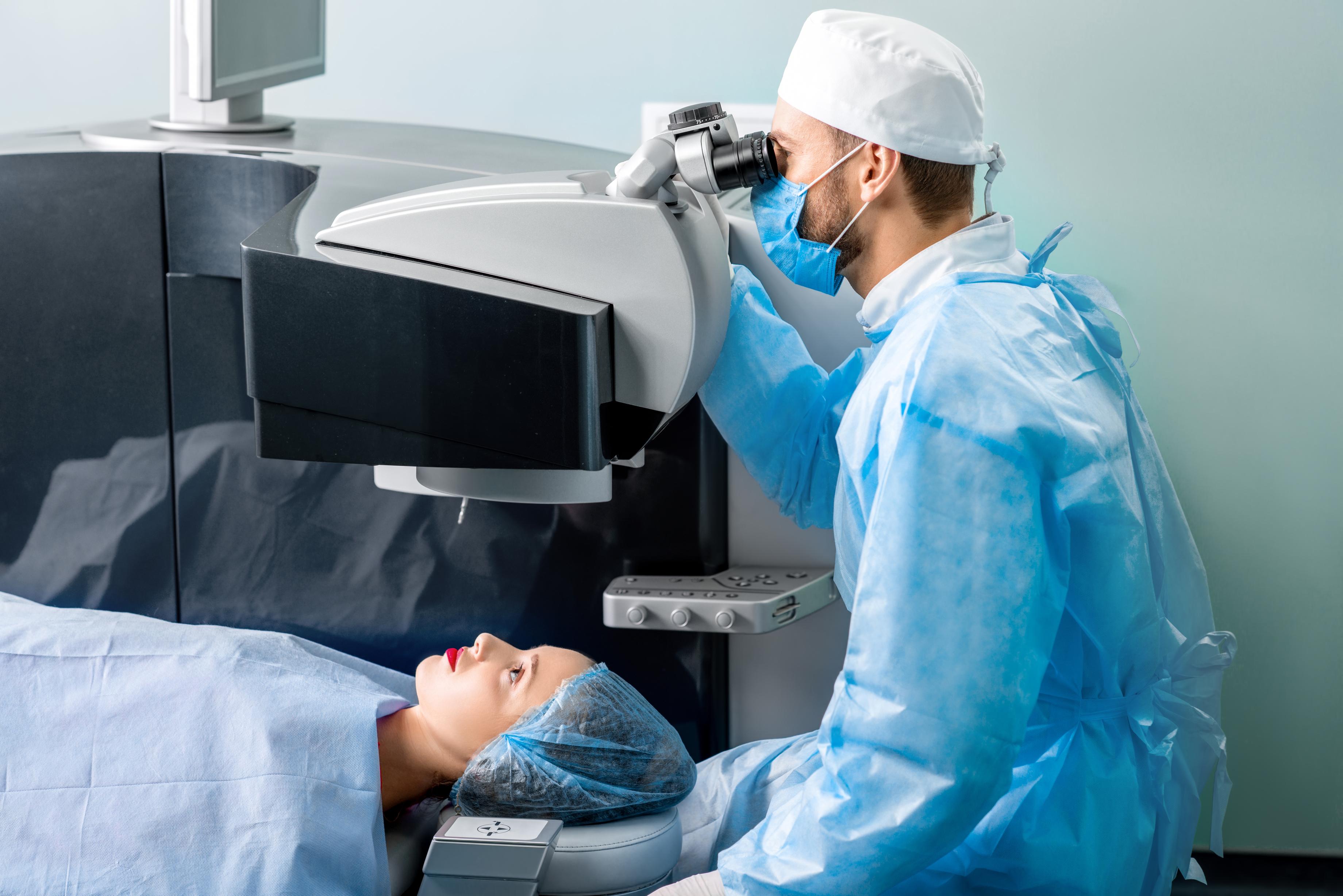
Excimer Lasers
Made from reactive gases combined with inert gases.
- Emit ultraviolet light
- Widely used in eye surgery (such as LASIK)
Dye Lasers
Use organic dyes in liquid form.
- Tunable across a wide range of wavelengths
- Used in spectroscopy and research
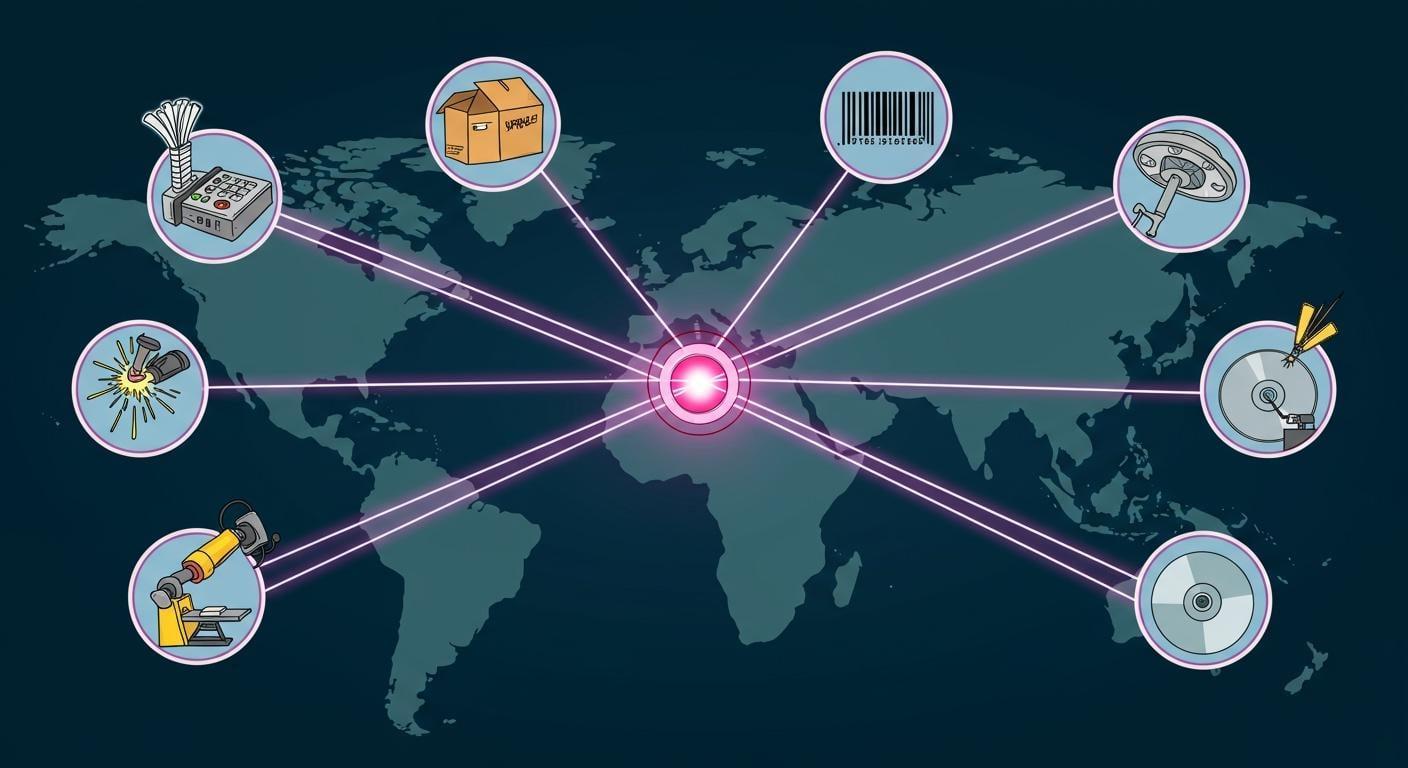
Semiconductor (Diode) Lasers
Small, efficient, and low-power lasers.
- Found in CD and DVD players
- Used in laser printers, barcode scanners, and fibre optics
Lasers in Everyday Life
While science fiction portrays lasers as futuristic weapons, their real-world applications are far more diverse and practical:
- Medical surgery (eye surgery, dental drills, tattoo removal)
- Engineering and construction alignment
- High-speed metal cutting
- Office printers and scanners
- CD and DVD players
- Banknote authentication using ultraviolet scanning
- Retail barcode scanning
Lasers are also essential tools in scientific measurement, communications, and modern manufacturing.
Final Thoughts
Lasers are a remarkable example of how controlled atomic processes can be harnessed to transform everyday life. By producing light that is monochromatic, coherent, highly directional, with intensity, lasers enable levels of precision that ordinary light simply cannot achieve.
From healthcare and engineering to entertainment and communications, lasers continue to shape the modern world — proving that what once seemed like science fiction is now an essential part of reality.


- News & Current Affairs
- Business & Economy
- Finance & Money
- Education & Learning
- Technology & Innovation
- Science & Environment
- Health & Wellness
- Food & Drink
- Home, Garden & Lifestyle
- Travel & Tourism
- Fashion & Beauty
- Art & Culture
- Entertainment & Media
- Sports & Recreation
- Personal Growth & Lifestyle
- Careers & Work
- Tutorials & How-To Guides
- Real Estate & Property
- Automotive
- Family & Relationships
- Environment & Sustainability
- Law & Legal Matters
- Gaming & Esports
- Religion & Spirituality
- Community & Local Voices
- Miscellaneous

 English
 Arabic
 French
 Portuguese
 Deutsch
 Turkish
 Dutch
Dutch
 Italiano
 Russian
 Romaian
 Portuguese (Brazil)
 Greek
Greek
