


Bushpig (Potamochoerus larvatus): Africa’s Secretive Forest Dweller
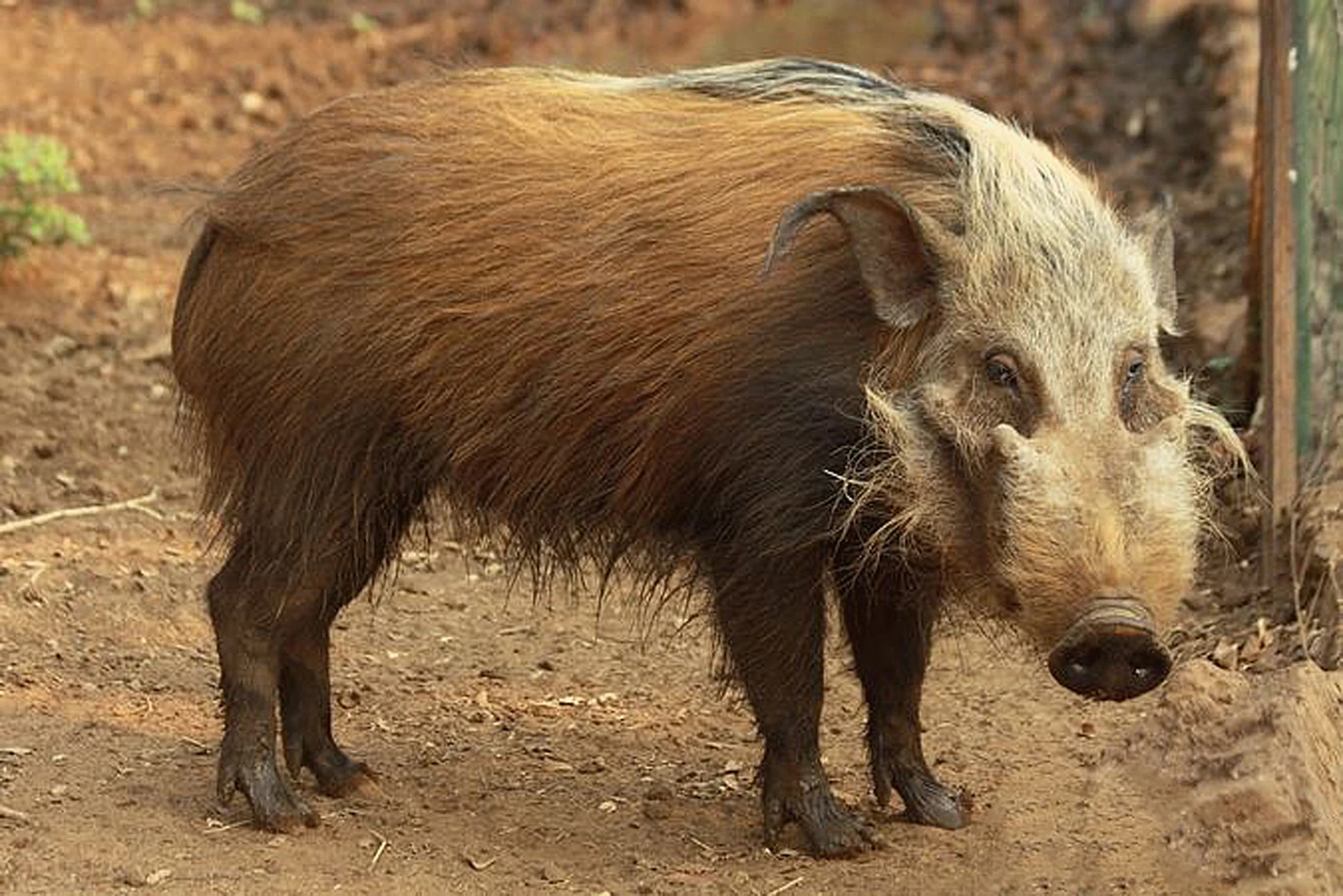
The Bushpig is one of Africa’s most adaptable and elusive wild pigs. More pig-like in appearance than the Common Warthog, the bushpig thrives in dense vegetation, wetlands, and riverine forests, where it lives a largely nocturnal and highly social life.

Physical Description
Bushpigs have a sturdy, well-proportioned body covered in long, coarse, bristle-like hair. Their coat colour ranges from reddish-brown to grey-brown, allowing excellent camouflage in forested and bushy environments. A mane of longer, paler hair runs from the back of the neck to the shoulders, while the facial hair is often grey-white.
They have long heads, pointed ears tipped with tufts of hair, and a thin tail ending in a black tassel. Older males may develop small warts on the muzzle, though these are much less pronounced than those of warthogs. Piglets are dark brown with pale longitudinal stripes, a feature that provides effective concealment in dense undergrowth.
Size:
- Total length: 1.3–1.7 m
- Shoulder height: 55–88 cm
- Tail length: 38 cm
- Weight: Average 60 kg (range 46–115 kg)
Distribution and Habitat
Bushpigs are widely distributed across sub-Saharan Africa. In South Africa, they are found in the Eastern Cape, KwaZulu-Natal, Mpumalanga, and parts of the Northern Cape, extending south to Mossel Bay. They also occur in countries such as Namibia, Botswana, Mozambique, Malawi, Ethiopia, Somalia, Angola, Rwanda, Burundi, and the Democratic Republic of Congo. Isolated populations are also present in Madagascar and the Comoros Islands, likely introduced by humans.
They occupy a remarkable variety of habitats, including forests, dense bush, riverine woodlands, reed beds, swamps, montane grasslands, shrublands, and flooded forests. Bushpigs readily adapt to human-modified landscapes and are often found near farms, where food is abundant.

Behaviour and Social Structure
Bushpigs are primarily nocturnal, becoming active at night to forage. In undisturbed areas or cooler months, they may also be seen during daylight hours. They usually move less than five kilometres a day.
They are highly social animals and live in sounders typically consisting of 8–12 individuals. A sounder is usually led by a dominant boar and sow, with the remainder made up of females and piglets. Solitary animals and bachelor groups do occur.
Bushpigs are territorial and can be aggressive when defending their area or young. Territory marking may involve dung middens, urine, scent secretions from facial glands, and tusking tree bark. If wounded or cornered, bushpigs can be extremely dangerous, using their sharp canines to inflict serious injuries.
Diet and Feeding
Bushpigs are adventurous omnivores. Using their powerful snouts, they root for rhizomes, bulbs, tubers, and roots, often leaving behind ground that looks like freshly ploughed soil. They also browse on vegetation and consume fruits and crops such as maize, sugarcane, potatoes, tomatoes, and other vegetables, making them a challenge for farmers.
Animal matter forms a significant part of their diet and includes insects, invertebrates, frogs, carrion, and on rare occasions small livestock. Their sense of smell is exceptional, bushpigs can detect carrion from several kilometres away and will travel across unfamiliar terrain to reach a food source.
Communication and Daily Life
Bushpigs are vocal animals and communicate using grunts, squeals, and growls. Soft grunts are common during foraging, while loud squeals and deep growls serve as alarm calls to warn the group of danger.
One of their favourite behaviours is wallowing in mud or water. This helps regulate body temperature, protects their skin from insects, and aligns perfectly with the meaning of their scientific name, loosely translated as “a masked pig of the river.”
Reproduction and Lifespan
Bushpigs have a polygynous mating system, where one boar mates with multiple females. Sexual maturity is reached between 18 and 21 months. Although mating can occur throughout the year, most breeding activity happens in autumn and winter, with piglets typically born in spring.
The sow builds a large grass “haystack” nest, sometimes up to 3 metres wide and 1 metre high, hidden in dense bush. After a gestation period of about four months, she gives birth to 2–4 piglets (occasionally up to 8), each weighing around 700–750 grams. Piglets are born in the centre of the nest, and care is shared, with the dominant boar playing an active role in defending and guiding the young.
Bushpigs usually live 12–15 years in the wild, though individuals in captivity have lived over 20 years.

Bushpig vs Warthog
Bushpigs are often confused with warthogs, but several key differences help distinguish them:
- Bushpigs have shorter tusks
- Broader hooves with visible dewclaw marks
- Bushpigs run with tails down, while warthogs run with tails upright
- Bushpigs prefer dense cover, whereas warthogs favour open grasslands
Conclusion
The Bushpig is a powerful, intelligent, and remarkably adaptable animal. Though seldom seen, it plays a vital role in African ecosystems as a forager, scavenger, and soil-turner. Its social structure, complex behaviours, and ability to thrive alongside humans make it one of Africa’s most intriguing wild pigs, deserving of respect rather than fear.

- News & Current Affairs
- Business & Economy
- Finance & Money
- Education & Learning
- Technology & Innovation
- Science & Environment
- Health & Wellness
- Food & Drink
- Home, Garden & Lifestyle
- Travel & Tourism
- Fashion & Beauty
- Art & Culture
- Entertainment & Media
- Sports & Recreation
- Personal Growth & Lifestyle
- Careers & Work
- Tutorials & How-To Guides
- Real Estate & Property
- Automotive
- Family & Relationships
- Environment & Sustainability
- Law & Legal Matters
- Gaming & Esports
- Religion & Spirituality
- Community & Local Voices
- Miscellaneous

 English
 Arabic
 French
 Spanish
 Portuguese
 Deutsch
 Turkish
 Italiano
 Russian
 Romaian
 Portuguese (Brazil)
 Greek
Greek
