


Bushbuck (Imbabala) – Tragelaphus sylvaticus
A Shy and Striking Forest Antelope
The Bushbuck, also known as Imbabala, is one of Africa’s most beautiful yet elusive antelope species. Found in dense bush and riverine forests, this small antelope is admired for its rich colouring, distinctive markings, and secretive nature.

Physical Description
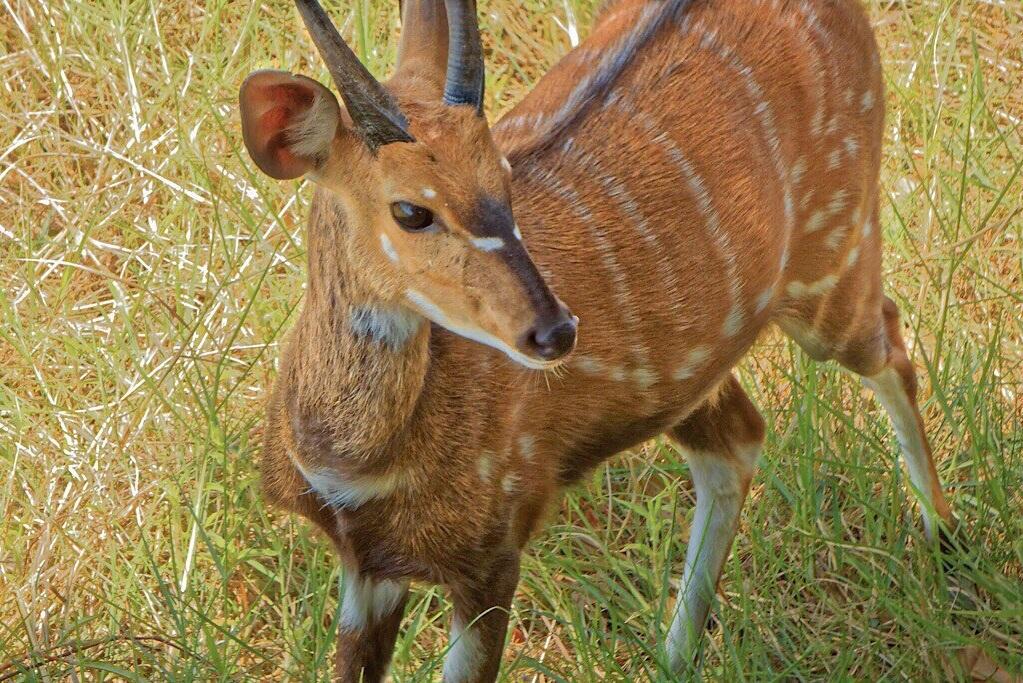
Bushbuck are small to medium-sized antelope with coats ranging from bright chestnut to deep dark brown. Individuals from northern regions are generally more vividly coloured and more boldly marked than those in southern populations, although considerable variation exists.
White markings decorate the flanks in the form of spots and stripes, especially in northern animals. Unlike the Sitatunga, Nyala, or Greater Kudu, the bushbuck may or may not have a broken white stripe between the eyes. However, it always has two distinct white patches on the throat.
Males (rams) possess backward-projecting horns that twist in a single spiral. These horns are sharply pointed in younger males and can grow impressively long. A crest of longer hair runs along the ram’s back and is raised when displaying or threatening rivals. The tail is bushy, white underneath and dark brown above.
Size:
- Male: 1.36–1.66 m long, shoulder height 80 cm, weight ~45 kg
- Female: 1.3–1.5 m long, shoulder height 70 cm, weight ~30 kg
- Average horn length: 26 cm
- Record horn length: 54.3 cm
Distribution and Habitat
Bushbuck occur along the southern coastal belt and in eastern and northern parts of southern Africa. They are strongly associated with water and dense cover.
Their preferred habitats include riverine woodland, bush near streams, coastal dune forests, montane forests, and thick vegetation ranging from sea level up to 1,800 metres in altitude in South Africa.
Some populations in far northern Angola may belong to the closely related Harnessed Bushbuck (Kewel), and taxonomic classifications continue to be studied.

Behaviour and Social Structure
Bushbuck are generally solitary. They are most often seen alone, though females may be accompanied by lambs or occasionally form small, loosely structured groups.
They can occur at relatively high densities in prime habitat with sufficient food and cover. While mainly nocturnal, bushbuck may also be active during cooler or overcast daytime conditions.
Home ranges vary widely, from as small as 2.5 hectares to as large as 120 hectares, depending on habitat quality and resource availability.
Diet and Feeding
Bushbuck are primarily browsers, feeding on leaves, shoots, herbs, fruits, and shrubs. They may also graze on grass when available.
In forestry plantations and agricultural areas, bushbuck may cause damage by browsing on young trees and crops.

Reproduction and Lifespan
After a gestation period of approximately 180 days, the female gives birth to a single lamb weighing between 3.5 and 4.5 kg. The young remains hidden for the first few months of life and begins regularly following its mother after about four months.
Bushbuck have two pairs of inguinal mammae. In the wild, they typically live between 8 and 13 years, while individuals in captivity may reach 12 to 16 years.

Conclusion
The Bushbuck is a striking and adaptable antelope that thrives in dense, water-associated habitats across southern Africa. Though shy and often unseen, it plays an important role in forest and woodland ecosystems as a browser. Its beautiful markings, solitary nature, and graceful presence make it one of Africa’s most fascinating and understated antelope species.


- News & Current Affairs
- Business & Economy
- Finance & Money
- Education & Learning
- Technology & Innovation
- Science & Environment
- Health & Wellness
- Food & Drink
- Home, Garden & Lifestyle
- Travel & Tourism
- Fashion & Beauty
- Art & Culture
- Entertainment & Media
- Sports & Recreation
- Personal Growth & Lifestyle
- Careers & Work
- Tutorials & How-To Guides
- Real Estate & Property
- Automotive
- Family & Relationships
- Environment & Sustainability
- Law & Legal Matters
- Gaming & Esports
- Religion & Spirituality
- Community & Local Voices
- Miscellaneous

 Arabic
 French
 Spanish
 Portuguese
 Deutsch
 Turkish
 Dutch
Dutch
 Italiano
 Russian
 Romaian
 Portuguese (Brazil)
 Greek
Greek
