


Rosalind Franklin: The Scientist Behind DNA’s Image

Rosalind Franklin was one of the most important yet long-overlooked scientists in the discovery of DNA’s structure. A brilliant chemist and X-ray crystallographer, her work helped unlock what is often called “the secret of life.” Although others received the Nobel Prize for the DNA model, Franklin’s research laid much of the groundwork that made their breakthrough possible.
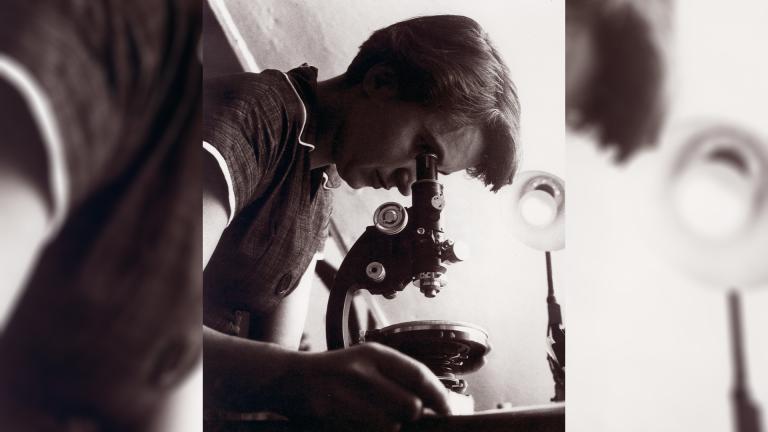
Early Life and Education
Born on July 25, 1920, in London to a prominent Jewish family, Rosalind Franklin showed exceptional intelligence from a young age. By 15, she already knew she wanted to become a scientist.
She attended St. Paul’s Girls’ School and later studied physical chemistry at Newnham College, Cambridge, graduating in 1941. During World War II, she worked for the British Coal Utilisation Research Association, where her research on the structure of coal earned her a Ph.D. in 1945. This early work later proved valuable in materials science and industrial chemistry.
Mastering X-Ray Crystallography
From 1947 to 1950, Franklin worked in Paris, where she became an expert in X-ray diffraction, a technique used to study the atomic structure of matter. She refined methods that produced some of the clearest X-ray images ever taken, setting a new scientific standard.
In 1951, she joined King’s College London, where she applied this technique to DNA fibers. Along with her student Raymond Gosling, she discovered that DNA had two forms:
- A dry A-form
- A wet B-form, which was biologically important
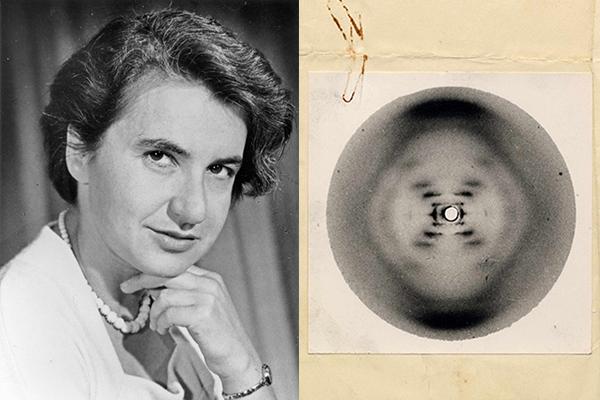
Her famous image of B-form DNA, known as Photo 51, showed a distinctive pattern revealing DNA’s helical structure.
The DNA Credit Controversy
Without Franklin’s knowledge or permission, her colleague Maurice Wilkins showed Photo 51 to James Watson, who was working with Francis Crick on a DNA model. The image confirmed their ideas about DNA’s structure and directly influenced their double-helix model.
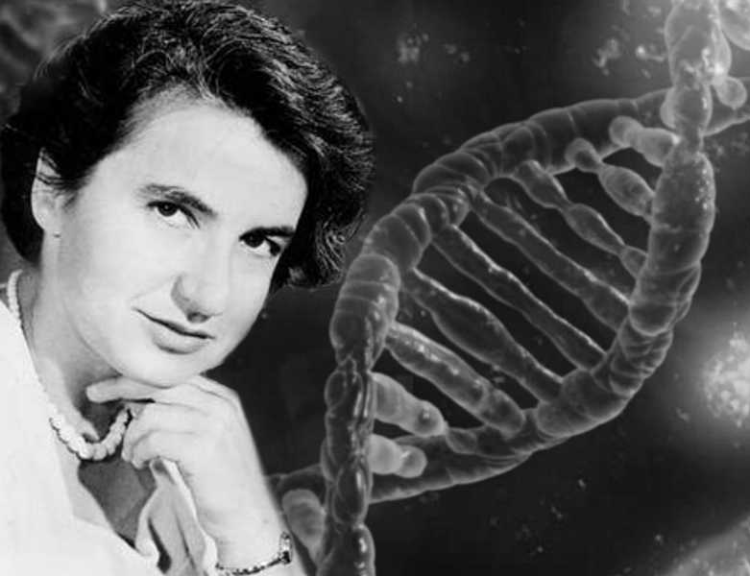
In 1953, Watson and Crick published their findings in Nature. Franklin’s own paper appeared in the same issue, but as supporting evidence rather than the primary discovery. While they went on to receive the 1962 Nobel Prize, Franklin was excluded because she had already passed away and the prize is not awarded posthumously.
Virus Research and Later Career
After leaving King’s College in 1953, Franklin moved to Birkbeck College, where she focused on the structure of viruses. She made major advances in understanding the tobacco mosaic virus and contributed to early research on polio and RNA. In just five years, she published 17 scientific papers in this field and helped establish modern structural virology.
Illness and Death
In 1956, Franklin was diagnosed with ovarian cancer. Despite undergoing surgeries and experimental chemotherapy, she continued working almost until her death on April 16, 1958, at just 37 years old. Some scientists believe her prolonged exposure to X-rays may have contributed to her illness.
Final Thoughts
Rosalind Franklin’s story is not only about science, it is about recognition, integrity, and perseverance. Her careful, methodical approach and extraordinary technical skill produced some of the most important data in biology. While she did not live to see her full impact acknowledged, she is now celebrated as a central figure in the discovery of DNA’s structure and a pioneer in virology and materials science.
Today, Franklin stands as a powerful reminder that scientific progress depends not only on bold theories but on precise, patient work behind the scenes. Her legacy continues to inspire generations of scientists, especially women in STEM, who follow in her footsteps.

- News & Current Affairs
- Business & Economy
- Finance & Money
- Education & Learning
- Technology & Innovation
- Science & Environment
- Health & Wellness
- Food & Drink
- Home, Garden & Lifestyle
- Travel & Tourism
- Fashion & Beauty
- Art & Culture
- Entertainment & Media
- Sports & Recreation
- Personal Growth & Lifestyle
- Careers & Work
- Tutorials & How-To Guides
- Real Estate & Property
- Automotive
- Family & Relationships
- Environment & Sustainability
- Law & Legal Matters
- Gaming & Esports
- Religion & Spirituality
- Community & Local Voices
- Miscellaneous

 English
 Arabic
 Spanish
 Portuguese
 Deutsch
 Turkish
 Dutch
Dutch
 Italiano
 Russian
 Romaian
 Portuguese (Brazil)
 Greek
Greek
